
7 minutes
You pay monthly for IT you don’t use. And you know it.
Every employee has a workplace. But not every employee does the same work. The account manager who makes the occasional quote has different needs than the designer who spends all day in heavy software. Yet most organizations pay the same for both: a fixed license, a fixed server, a fixed workstation.
Citrix is trying to change that with a new model: Citrix Platform Flex. And for SMB organizations using Citrix, or just doubting whether they should continue to do so, this is worth understanding.
What exactly is Citrix Platform Flex?
Citrix Platform Flex is a new workplace model for virtual workstations, launched in May 2026. It is not a new version of CVAD or an update to DaaS. It is a different way of licensing and purchasing.
The key idea: you no longer pay for fixed infrastructure or a fixed number of users, but per persona, per month, based on what someone actually needs.
Citrix manages the underlying infrastructure entirely in-house, through Microsoft Azure. You manage the applications, the policies and the user experience. The servers, maintenance, patches and availability are Citrix’s problem.
For SMB organizations without a large internal IT department, this is a relevant promise. You don’t need an in-house Citrix expert to deliver a stable, secure virtual workspace.
What are personas and why does it matter to you?
The central concept in Citrix Platform Flex is the persona. A persona describes a type of user and determines what computing power, how much storage and what type of workstation that user gets.
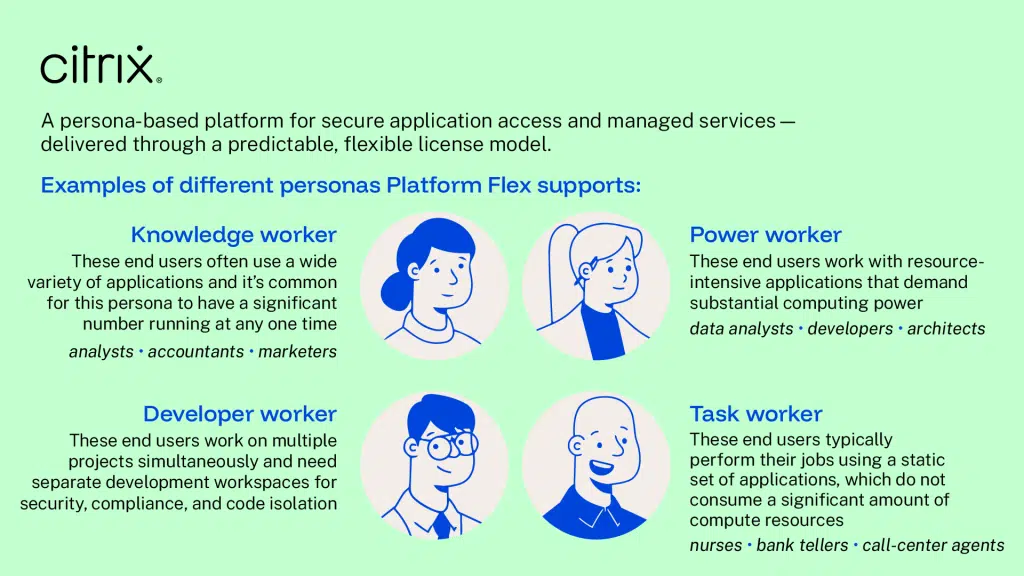
Four standard personas are currently available:
Knowledge worker: for analysts, accountants and marketers who use a wide mix of applications on a daily basis. This is a single-session desktop on Windows 11. Cost: 60 credits per user per month.
Power worker: for data analysts, developers and architects with heavy graphics or computational needs. Includes GPU. Cost: 200 credits per user per month.
Developer worker: for developers who work simultaneously on multiple projects and need separate working environments for security, compliance and code isolation. Credits to follow based on final configuration.
Task worker: for employees such as nurses, bank employees and call-center agents who work daily with a fixed set of applications without heavy computing power. Available as Medium (8 users per server, 25 credits per month) or Heavy (4 users per server, 35 credits per month).
Credits are the internal currency of the system. You buy a package of Flex Credits and divide them among the personas that fit your organization. Does an employee need a lighter or heavier workstation? Then you adjust the persona, without a new contract or server rollout.
What does Citrix Platform Flex compare to the old model?
With the traditional Citrix model, you buy licenses on a per-user or per-device basis, and either build or rent the infrastructure yourself. That requires technical knowledge, management and budget for hardware or cloud resources.
With Citrix Platform Flex, Citrix buys that infrastructure, manages it itself and delivers it as a service. You pay a monthly fee based on how many users you have and which personas use them.
The comparison relevant here is for SME:
Traditional model: capital intensive, requires internal or external Citrix expertise, you are responsible for uptime, patching and capacity planning yourself.
Platform Flex: operational model, no own infra responsibility, predictable monthly costs, scales with your organization.
What are the risks of switching?
As with any new workplace model, there are issues to be keen on.
Platform Flex will be available in its initial release as of May 2026, exclusively for Microsoft Azure. Other cloud platforms are not supported in this initial release. If your organization is not on Azure or does not want Azure integration, you are currently relying on other options.
The model works best if you know how many users you have and which personas fit them. If you have a very changing workforce or many temporary workers, that requires good monitoring of your credit usage to avoid unexpected costs.
Standard dashboards for knowledge workers are persistent and require an additional disk add-on on top of the base price. A 128 GB Standard SSD costs an additional 10 credits per month; a 512 GB Premium SSD runs to 75 credits. Do the math before you choose.
Does this model work for organizations without a large IT department?
That’s exactly the question we ask ourselves with every client. And the honest answer is: it can be done, but not without proper guidance at the start.
The strength of Platform Flex is that Citrix fully manages the infrastructure. That saves a sysadmin keeping up with Citrix updates, rebooting servers and scaling capacity. That’s a real advantage for SMB organizations.
But the model requires a good initial setup. What personas do you need? How many credits do you need? How do you integrate this with your existing Microsoft 365 environment, your Active Directory or Entra ID? What do you do with applications running locally?
These are questions you should not answer based on a brochure, but on an analysis of your workplace.
What does this mean if you are already using Citrix?
If you’re already working with Citrix CVAD, Citrix DaaS or an on-premises Citrix environment, Platform Flex is not an automatic replacement. It is a complementary route, for organizations looking to make the move to fully managed infrastructure without in-house servers or cloud resources.
The transition requires:
- Inventory your current users and work patterns
- Link to your existing license structure (including any LAS migration for on-premises licenses)
- Choosing the right personas
- Thinking about what happens to your current Citrix environment during the transition
Not going full transition? Then you can also run Platform Flex alongside your existing environment, for a specific group of users or as a test bed for a larger rollout.
Practical checklist: is Citrix Platform Flex right for your organization?
Answer the following questions honestly:
- Does your organization work in or with Microsoft Azure?
- Want to get rid of the responsibility of Citrix infrastructure management?
- Do you have clear user profiles for which you can choose an appropriate persona?
- Do you want predictable, monthly costs rather than capital expenses?
- Don’t have strict compliance requirements that require all data to remain on-premises?
The more questions you answer yes to, the more relevant Platform Flex is to you.
How does New Yard view Citrix Platform Flex?
We see Citrix Platform Flex as a serious option for SMB organizations that want stability and simplicity, without compromising on security or user experience.
But it’s not a button you just flip. It requires a clear translation of your organization into the right personas, a good connection to your Microsoft 365 environment and a well thought-out migration path if you already have an existing Citrix environment.
That’s exactly what we help in. We don’t look at a product, we look at the digital workplace as a whole. What do you need? What suits your people and your organization? And how do you ensure a smooth transition?
Want to know what Citrix Platform Flex means for your organization?
Schedule a no-obligation introductory consultation through newyard.com. Together we will look at your current situation and give you honest advice on whether this model suits you.