
6 minutes
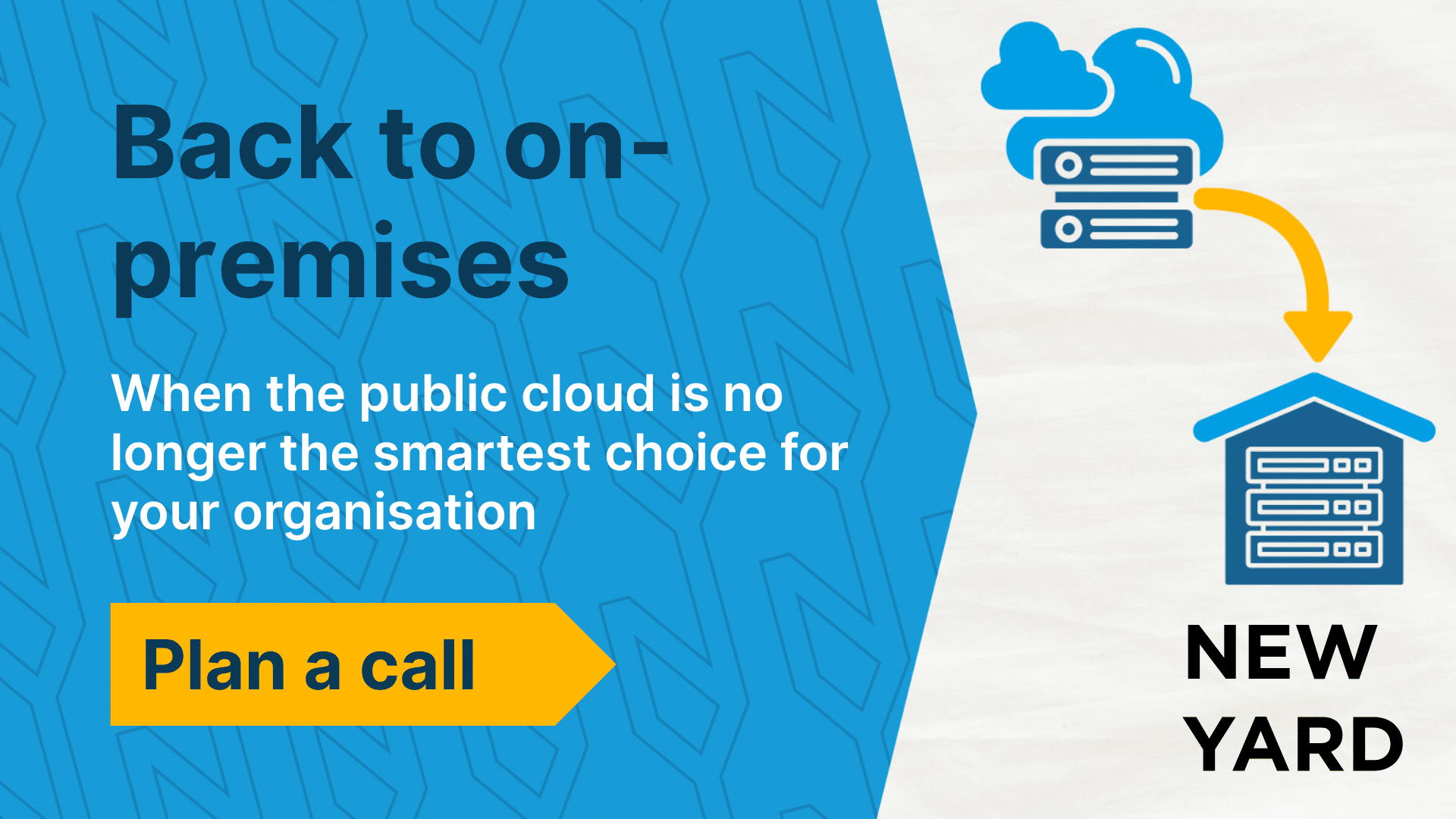
When the public cloud is no longer the smartest choice
Ten years ago, moving to the public cloud seemed like a no-brainer for many organizations. Flexible, scalable, always up-to-date and someone else turns around to manage it. It sounded perfect. And for many workloads, it is.
But something has changed in recent years. Organizations are starting to look more critically. Not because the cloud is bad, but because the world around it has changed. Geopolitical tensions, new European legislation and rising cloud bills are causing more and more IT managers and directors to ask themselves the same question:
Are all our systems actually in the right place?
The cloud hasn’t disappeared, but the context has
When the great cloud migration wave began, the world was a different place. Data sovereignty was a niche topic. The Cloud Act was not yet widely known. GDPR was just around. And political relations between Europe, the U.S. and the rest of the world seemed more stable than now.
Meanwhile, the landscape has changed completely. Governments are placing stricter requirements on the location of sensitive data. The European Data Act and additional national legislation require organizations to think carefully about where data is stored and who has access to it. Organizations in sectors such as healthcare, government, financial services and critical infrastructure are directly affected.
At the same time, the public cloud itself is not sitting still. Rates have risen. Data transfer costs that initially seemed marginal are rising sharply as data sets grow. And for workloads that are stable and predictable, the business case for the cloud is a lot less sharp than it was a few years ago.
That makes the question “should we go back?” increasingly legitimate.
Why organizations are choosing to return to on-premises
There is rarely a single reason. Usually it is a combination of factors that add up to a tipping point.
Data sovereignty and compliance
Sensitive corporate data, personal data or data covered by industry-specific regulations are, in more and more cases, simply not allowed to be outside the EU, let alone outside their own organizational borders. A cloud environment run by an American company falls under U.S. law, even if the data centers are physically located in Europe. That has become an uncomfortable reality for many organizations.
Geopolitical uncertainty
The relationship between the EU and the US is strained. Trade conflicts, sanctions policies and export restrictions create uncertainty about long-term contracts with U.S. cloud providers. Organizations that depend on a single provider for their critical systems now feel that dependence as a vulnerability.
Cost control
The first few years in the cloud often seem advantageous. But as the environment grows and becomes more complex, the costs add up. Storage, computing power, outbound data transfers, licensing structures that pay double in hybrid environments; for stable workloads without large spikes, a properly set up on-premises system is cheaper in the long run.
Control and transparency
In an in-house data center, you know exactly where your data is, who can access it and what happens to it. In the cloud, that is more dependent on the provider’s policies. For organizations with strict audit obligations or high security requirements, that control is not a luxury, but a requirement.
What does work: the hybrid approach
A full cloud exit is neither realistic nor wise for most organizations. The public cloud has real benefits for specific use cases: burst capacity, AI services, global availability, DevOps environments and rapid innovation pathways.
What does work is to make a conscious choice per workload. Not everything in the cloud because you can, and not everything on-premises because it’s familiar. But a structural evaluation based on:
- How sensitive is the data?
- How stable and predictable is the workload?
- What are the compliance requirements?
- What is the actual total cost over three to five years?
- What is the impact if the provider fails or the terms change?
Organizations that get this right usually end up with a hybrid model: critical and sensitive systems on-premises, flexible and innovative workloads in the cloud. With a good integration strategy, central monitoring and a clear governance model.
Common objections, answered honestly
“On-premises is obsolete, right?”
This is a misconception that has been actively nurtured by the cloud industry. Modern on-premises infrastructure with hyperconverged systems, software-defined networking and automated management is technologically mature. It is different than it was a decade ago.
“We don’t have the people to manage it.”
That’s a legitimate point. But a Digital Workplace Expert like New Yard can take full charge of managing on-premises systems. You don’t necessarily need in-house specialists.
“Migrating back costs too much.”
It depends on what you compare it to. If current cloud costs increase year on year, compliance risks increase and dependence on a foreign provider is seen as a risk, then the business case changes quickly.
“We just finished migrating to the cloud.”
Then this is the time to critically evaluate what you have accomplished and whether the assumptions made at the time are still correct. That’s not failure; that’s mature IT management.
A practical checklist for your evaluation
Use these steps as a starting point for honest consideration:
- Map your workloads. What is running in the cloud, for how long, and with what frequency is it being used?
- Identify sensitive data. Which systems contain personal data, mission-critical information or data covered by industry-specific regulations?
- Calculate the actual cost. Includes data transfer, licensing, management and the cost of any downtime or compliance incidents.
- Assess your compliance obligations. Are there changes in laws and regulations that affect data location or access rights?
- Analyze dependency. How vulnerable are you if your primary cloud provider changes its terms, fails or becomes subject to geopolitical measures?
- Determine the best place for each workload. Not everything has to go in the same direction. Make conscious choices.
- Plan the transition in phases. Start with the workloads where the business case is strongest, and build a hybrid architecture from there.
How New Yard looks at this
At New Yard, we don’t believe in platform dogma. Not the cloud as the holy grail, not on-premises as nostalgia. We do believe that the digital workplace should be built on a foundation that fits your organization: your risk profile, your compliance requirements, your costs and your management capacity.
We help organizations with an honest evaluation of their current cloud environment, identifying risks and designing an architecture that is technically strong and strategically sustainable.
Sometimes that means more cloud. Sometimes less. Usually a hybrid model that is deliberately set up, rather than historically grown.