

There is a newer LTSR: read about 2607
Why this new LTSR release is important
Citrix has released its latest Long-Term Service Release (LTSR) for Citrix Virtual Apps and Desktops (CVAD): version 2507.
With over 400 new features, improved integrations, and the transition to an annual LTSR cycle, this is not just another maintenance update. For many organizations, it represents an opportunity to both modernize and stabilize their Citrix environment.
But what exactly is included in this release? And how will it affect your environment?
The difference between LTSR and CR
Citrix has two release types: Long-Term Service Release (LTSR) and Current Release (CR). Choosing between these two determines how stable or innovative your Citrix environment is.
LTSR: stability and security
- 3 years of mainstream support and 2 years of extended support
- Only security updates and bug fixes (no new features)
- Reduced risk of disruption from unexpected changes
- Ideal for industries with compliance requirements or organizations that need predictability
CR: innovation and speed
- Short release cycles with new features and enhancements
- Always the latest features available
- More flexibility, but also more management effort
- Useful for organizations that want to be ahead of the curve and have the capacity internally to upgrade faster
In short: LTSR is all about calm and predictability, while CR is all about innovation and pace.
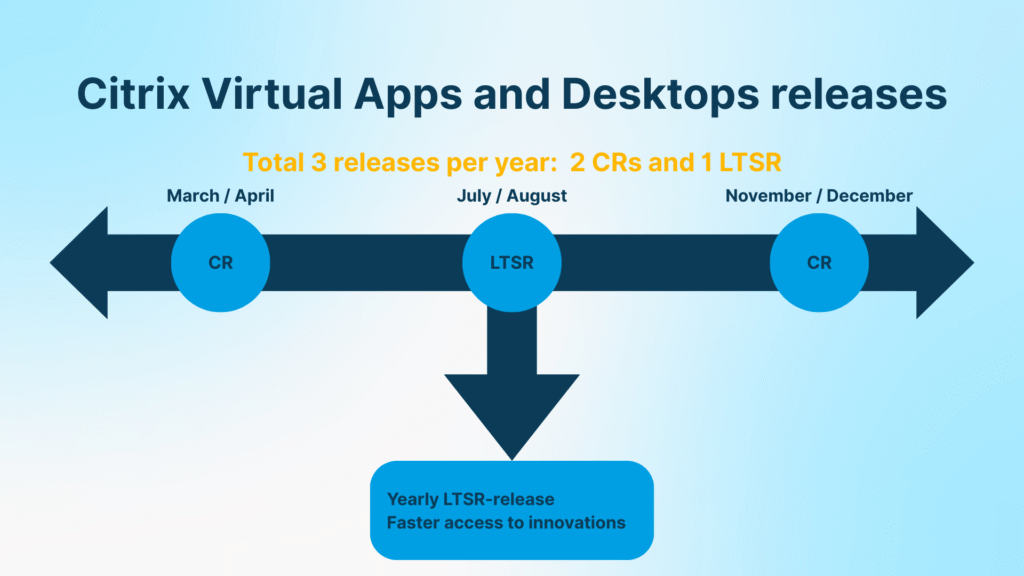
What’s new is that Citrix will now release an LTSR annually, instead of every 2–3 years.
Key new features in CVAD 2507 LTSR
The 2507 release builds on 2503 and includes more than 400 improvements compared to the previous LTSR, 2402. The most notable ones are:
1. UberAgent integrated by default
UberAgent is now part of the Citrix Workspace App and the VDA. This gives IT teams better insight into performance and user experience.
Advantages:
- More Comprehensive Metrics in Citrix Director
- Improved visibility of session performance
- Less dependence on loose agent installations
Please note: The standard dashboards only work with Splunk. For full dashboards, an external data repository such as Splunk, Elastic, or Azure Monitor is still required.
2. Device Trust: device-level access control.
Another important new feature in 2507 is Device Trust. This feature makes access to the Citrix environment dependent on the device a user uses to log in.
What this provides:
- Additional security: Only devices that meet predefined requirements are granted access
- Integration with policies: for example, rules such as allowing access only from managed laptops or prohibiting access from unsecured devices
- Part of Zero Trust security: not only is the user verified, but the device is as well
Device Trust responds perfectly to hybrid working: flexibility for employees but maintaining control for IT.
3. HDX enhancements for audio and video.
- Improved optimization for Teams, Zoom, and Webex
- Automatic fallback in case of network problems
- New codecs for lower latency and better quality
4. Comprehensive Citrix Director
- New tabs for user behavior insights and real-time monitoring
- Full integration of session startup breakdown and logon analysis
- Alerts on delays in policies, profile load or network latency
5. Always On Tracing (AOT).
With Always On Tracing (AOT), Citrix shortens the often time-consuming troubleshooting process.
- Continuous light data recording within your own environment
- Logs are both human-readable and machine-readable
- Directly integrated into Citrix Director
- Focuses primarily on launch and resource issues
Because an average support case at Citrix can now take 46 days mainly due to log collection, AOT can significantly reduce resolution time.
Windows Server 2016 no longer supported
A major milestone in LTSR 2507: Windows Server 2016 is no longer supported.
Organizations still running this version must upgrade to Windows Server 2019 or 2022. Continuing to use the 2016 version poses risks:
- No access to the latest fixes and optimizations
- Greater chance of security breaches
- Potential compliance issues in regulated industries
This makes the upgrade not only technically necessary, but also strategic.
Why this LTSR release is a tipping point
Moving to an annual release cycle means:
- More predictability in updates
- Faster access to bug fixes and performance improvements
- Simpler Decision-Making for IT Teams
Organizations must now make a conscious choice: stick with CR for innovation or upgrade annually to LTSR for stability.
Who is CVAD 2507 LTSR of interest to?
This release is particularly suitable for:
- Organizations already working with LTSR (e.g., 2402)
- IT teams that value stability and predictability over innovation
- Environments without a large internal Citrix management team
- Air-gapped networks or sectors with strict compliance requirements
- Citrix environments where deep insight into performance is critical
Less suitable is this release for organizations that constantly want the latest features and work with an agile DevOps approach.
Conclusion: a stable workplace, ready for the future
CVAD 2507 LTSR is not just a minor update, but a powerful release that addresses real-world needs: greater insight, improved performance, enhanced security, and more control.
For organizations seeking peace of mind and predictability in the digital workplace, without compromising on security and user experience, now is the time to plan the switch.